Friends often ask me how I do the historical research for my essays and stories, thinking it requires access to materials and skills that are beyond them. The truth is, most of the resources I use are free and available online or in your local community. You just need to know where to look. Here’s a round-up of some of my favorite resources that you should tap into (and there are plenty more!) if you are doing your own genealogical research, learning the history of your house, or finding what you can about certain events or people from the past.
WHO IS CAPTURED IN THE PRESERVED RECORD?
First, what might seem like an obvious disclaimer: Simply because you can’t find a record of it, doesn’t mean it didn’t happen. Records are made and preserved by those with either the resources, time, or tenacity to keep them, and those are the people who decide what is kept and what is not. Here in the U.S. you will find the most records relating to upper- or middle-class white people. There will be more records about the men than any other gender. Those judged insane or insolvent, immigrants or indigenous or slaves or their descendants are often purposefully erased and therefore much harder to trace using the means I outline below. This is a bias of the record that we must contend with, and sometimes imagine beyond. I love Saidiya Hartman’s book Wayward Lives, Beautiful Experiments for how it attempts to move past these limitations. I also love a much older book, Mysteries of Paris: The Quest for Morton Fullerton, for how it represents the way a historical figure’s story changes over the course of the research process.
Do everything you can to find your people and tell their stories.
ANCESTRY, FAMILYSEARCH & HERITAGE QUEST
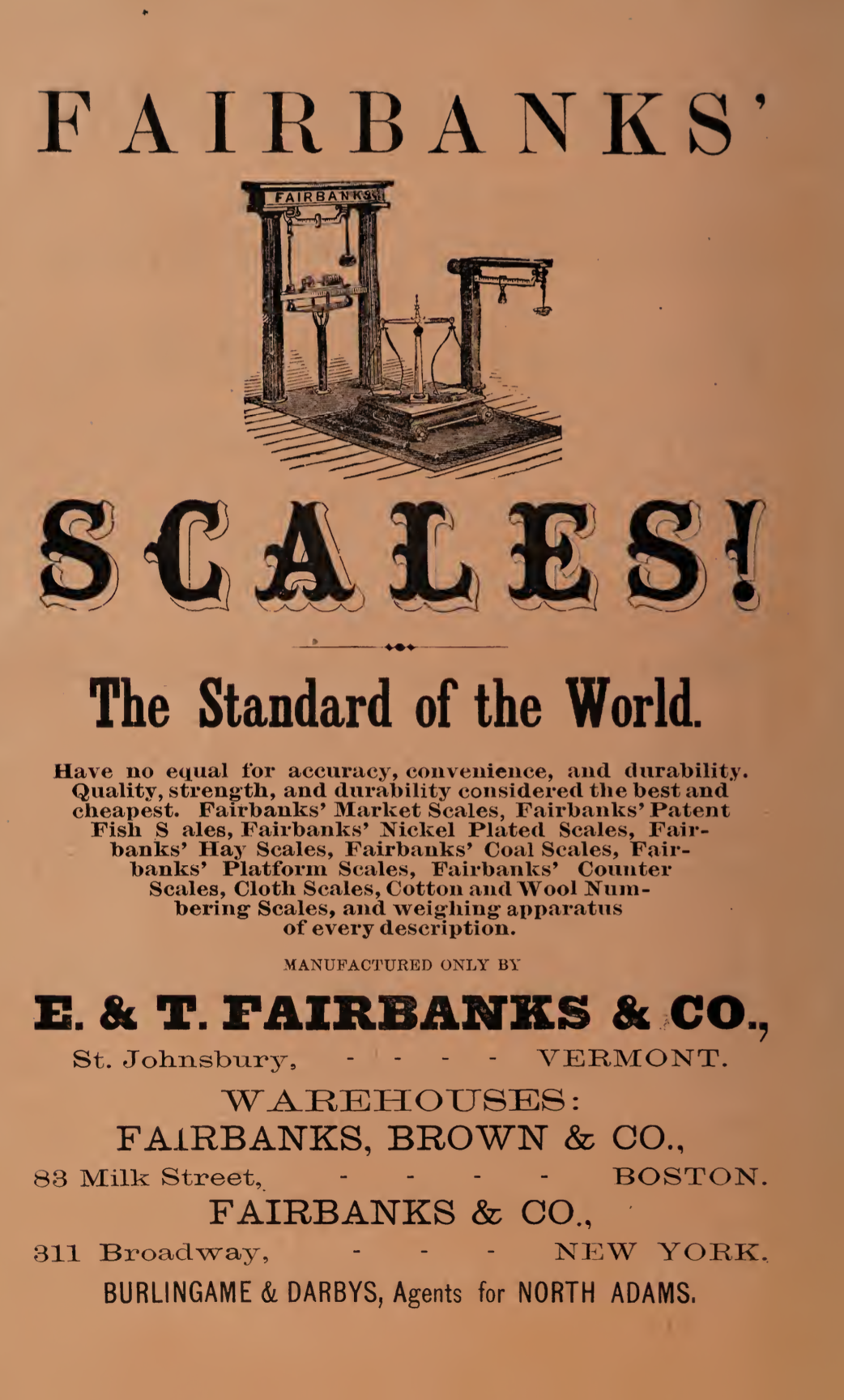
Ad in the 1880 North Adams (MA) city directory
These are three major databases I use that have some similarities. The most well known is Ancestry, unfortunately owned by Blackstone (which also owns several of the other resources below). This database has several functionalities, including the ability to search a single name and see results in a myriad of different collections, including Federal & State census records, immigration records, ship manifestoes, city directories, and more. Much of the records are digitized, so you can look at images right there. It also has the social/crowd-source function where users can build family trees, link their trees to others’ trees, and tie records to trees, so that you can see the (possible) lineage of almost any person who turns up in your search results. Use this crowd-sourced knowledge with a grain of salt, because duplication and user error certainly exists in there.
Ancestry has a hefty subscription price-tag for a personal account, but most libraries have their own subscription, which you can access for free. Depending on your library, you might be able to tap into their free account from home or you may need to physically be at the library to use the database on one of their desktop computers.
If you don’t want to go to the library or your local library doesn’t have an Ancestry subscription, a free alternative with similar functionality is FamilySearch, which is operated by the LDS Church. Like with Ancestry, you can see crowdsourced family trees and link records to people on those trees. It has some limitations, though. Unlike Ancestry, which has scanned images of much of the records it turns up, FamilySearch might return records that can only be seen on Ancestry or other physical media.
Heritage Quest has census and immigration records and city directories., and is another one that your library might have free remote access to. It’s much more limited and doesn’t have the family tree function, but I like it for when I’m only interested in browsing a very specific collection.
NEWSPAPERS.COM, CHRONICLING AMERICA & OTHER DIGITAL NEWSPAPERS
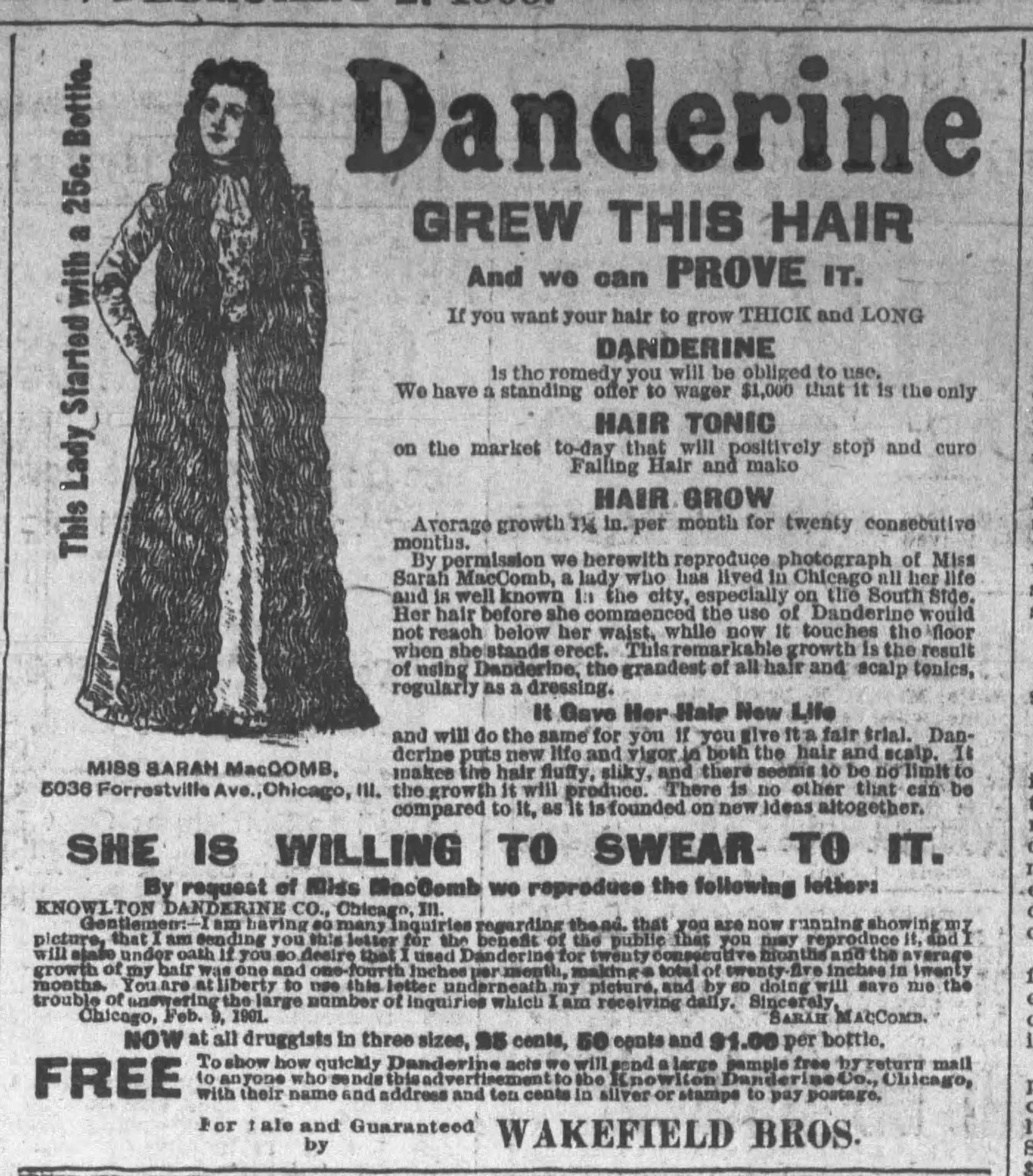
I’ve clipped hundreds of newspaper articles and adverts like this one on Newspapers.com
Newspapers.com
Also owned by Ancestry, Newspapers.com is hands down the number one resource I use in understanding what information I need to hunt for elsewhere (it’s also the only one I’ll recommend that requires a paid subscription). Back in the day, newspapers doubled as your social media feed, which meant that not only were the actual newsworthy events recorded, but also the little things: “Louis Niles was in town to visit his parents” or “Mr. Avery has a fresh delivery of potatoes for sale at his store.” It captured full transcripts of lectures given to fraternal societies, what cases are coming up on the county court’s docket, and sometimes even coroners’ reports of untimely deaths.
I like to use Newspapers.com as a place to get the lay of the land of a person’s life. It fills in the everyday color that census records and city directories don’t. It also helps point me to where I might want to dig deeper. If a court hearing is mentioned as coming before a judge, then I can reach out to that courthouse to learn who houses their historic court records to get the full file. If I learn that someone moved to Colorado Springs, then I know to find out if the Pioneer Museum has anything in their holdings related to whomever I’m researching.
The site has a great search feature, that allows you to narrow by dates, country (they have international papers too, mostly English colonies). The preview images allow you to see the relevant snippet of the page, so you can quickly determine whether it’s of interest. The company is always adding newly digitized newspapers, so the archive keeps growing! Pro tip: Sort your results by paper date, so that repeat articles (news published across multiple papers) or advertisements are grouped together. It helps you with quick skimming to easily know you’re looking at the same news item that you already saw.
Chronicling America & Other Digital Newspaper Databases
If you don’t want to pay for Newspapers.com, or the site isn’t returning what you’re looking for, there are several other digital newspaper repositories to check out as well. The Library of Congress has Chronicling America, with (as of this writing) about 4,500 newspapers digitized and searchable. Unfortunately, I find their search function significantly less user-friendly than Newspapers.com. The text preview isn’t as robust, so I find it harder to know if the search result is relevant, and when I click on a result, it shows the the full, zoomed out newspaper page, so I have to manually zoom into the highlighted search result. But it’s a free resource, provided by taxpayers, which is amazing!
You’ll discover, based on the state you’re researching, that either Newspapers.com or Chronicling American might have more results. That’s because much of the source material for these sites are provided by state archives, and each state decides which it wants to contract with. Other states, like Colorado, decided to make their own digital newspaper database. Other small communities might have digitized their own newspaper before the big guys have, like the Valley Gleaner at Lee Library (MA) or the Piscataquis Observer in Dover-Foxcroft, ME. So don’t rely entirely on the big databases—do some googling or check the local library’s digital resources!
FIND A GRAVE

If, like me, you enjoy wandering cemeteries and snapping photos, this might be your next crowdsource community! Find a Grave is another Ancestry subsidiary. For a researcher, this site allows you to see pictures of the gravestone of a person you’re looking for, and also links to the gravestones of their known relatives. Community members upload photos they’ve taken at cemeteries, and sometimes also other images, like obituary clippings or family photos. If you want to visit the grave of someone, this resource really helps you find the stone needle in the haystack once you get to the cemetery! And if you choose to create an account (you don’t have to in order to use the site), you can select your geography and get requests for photos, if someone is looking for the picture of a headstone in a cemetery near you, but the site is still missing a picture. Weekend adventure to help someone else’s research? Yes, please! Find a Grave also has a great mobile app, for the explorer on-the-go.
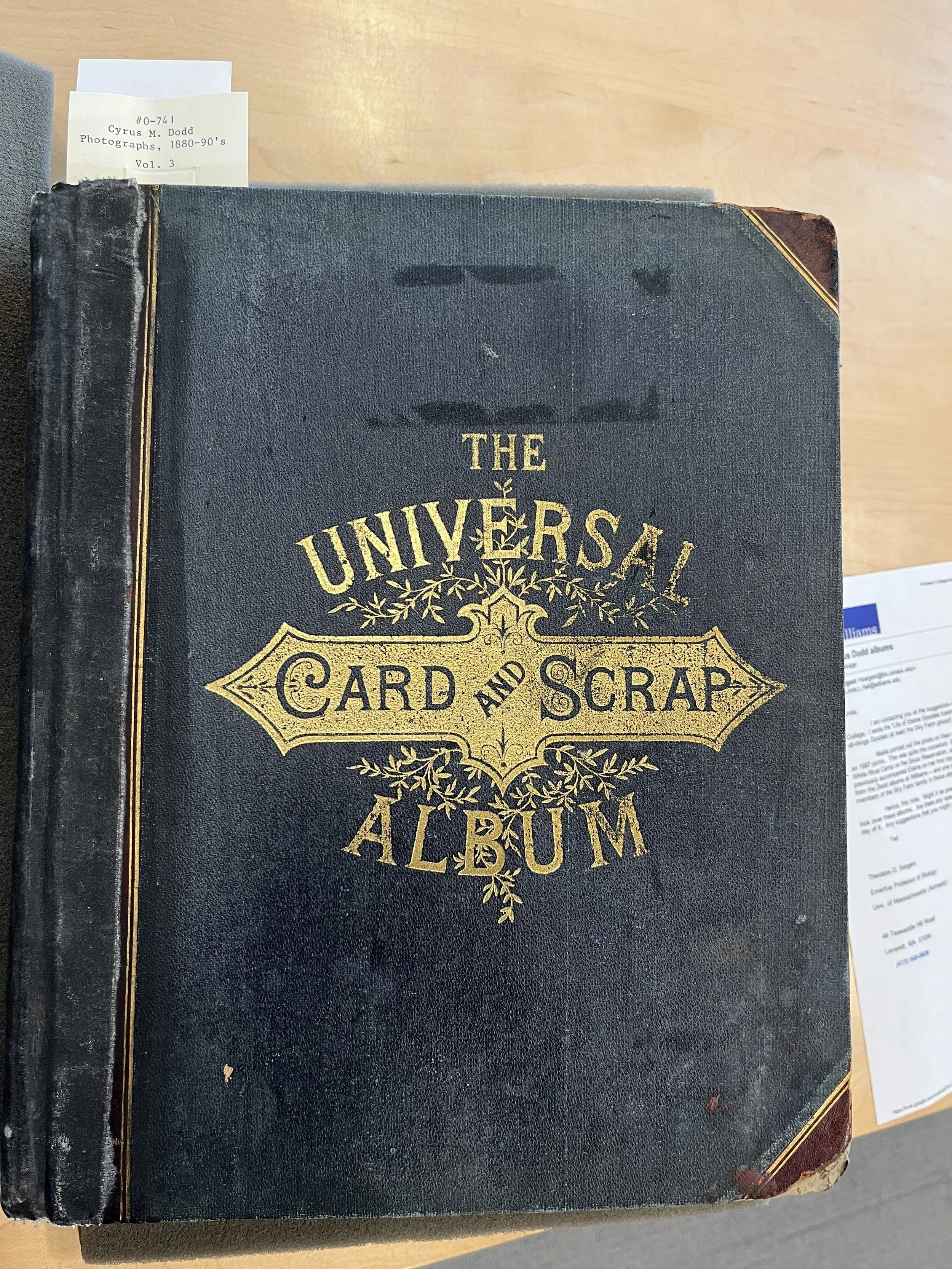
A photo album of the Dodd Family of Williamstown, MA, found in the ruins of a cabin in Savoy, MA, and now held at Williams College .
LOCAL LIBRARIES, HISTORICAL SOCIETIES & STATE ARCHIVES
While all of the recommended resources so far has been digital archives, the local, in-person archives are still the juiciest repository of so many un-digitized photos, newspapers, objects, and ephemera that you’ll never see anywhere else. State archives should have all of their holdings catalogued, but that’s not always the case for small town historical societies or libraries, and you just have to dig (isn’t that part of the fun?). In recent years I’ve visited physical archives to get to look at a twelve-year-old’s diary, photo albums discovered in an abandoned cabin, intake records of a now-defunct local hospital, the accounting books of a mental health hospital’s baseball team, and glass plate negatives of an amateur photographer. I once discovered a local historical society had over 100 years of letters between my ancestors (the family had no idea they existed). I really can’t say enough about how important the work is of local archives.
State archives are excellent when you’re looking for official government documents, such as prison, court, or probate records. Different states organize historic records differently, so you might find a local courthouse has what you’re looking for in one state, but the same year of records is held in the state repository in another state. I’ve found the archivists who work for these places to be incredibly helpful and generous with their time, so it doesn’t hurt to email or call to ask if they know where you might find whatever official record you’re looking for—if it still exists. Oftentimes they can even scan a small number of pages for you for free or a small fee, if you can’t visit in person.
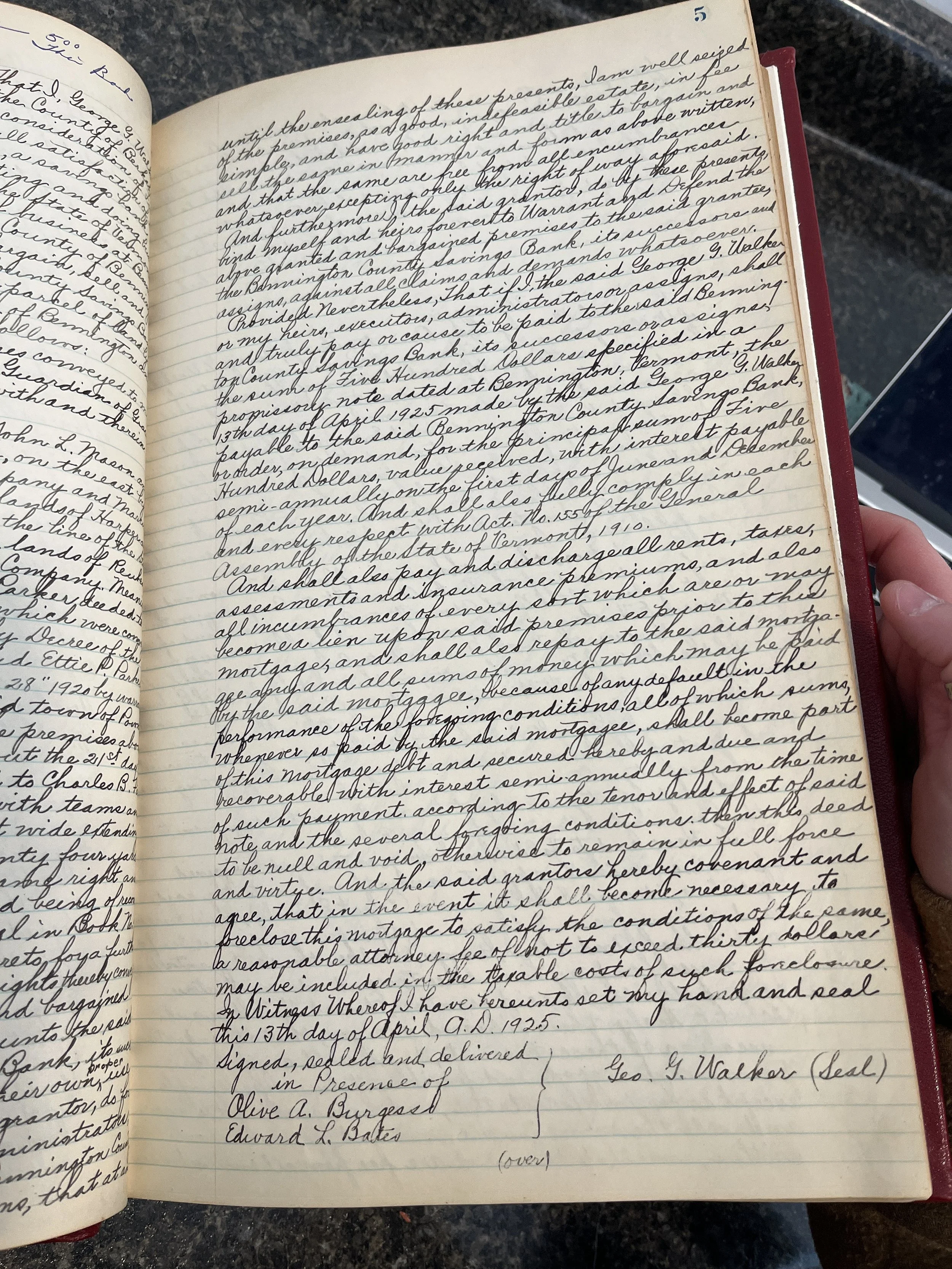
A deed recorded in the 1920s, in the vault of the town of Pownal, VT.
REGISTRY OF DEEDS
This is specifically if you’re researching a property. Maybe it’s your own, or maybe you want to learn from whom someone bought their house or to whom they sold it. Your city might have its own Registry of Deeds, or it might be for the entire county, but somewhere there is a record of every property transaction officially recorded with the state, and in most states it’s all public for you to explore! Usually you’ll need the exact address. Some let you search by name. While more recent records are usually digitized (and some even searchable online), the older records are in massive, handwritten books and need to be visited in person. The page that lists the transaction will tell you which book and page to find the previous transaction, so you’ll find yourself pulling half a dozen massive tomes off the shelf to trace back a single property. It’s simultaneously fun and overwhelming.
COLD CALL / COLD EMAIL
I still do a lot of cold calls and cold emails, even with access to all of the archives above. I’ve even sent letters through the post. I’ve cold called or emailed police stations, hospitals, land conservation nonprofits, fellow researchers, descendants of people I’m researching, and people who I’m not totally sure are descendants of people I’m researching. You never know who will hold a missing piece of your puzzle, and the worst they can do is say no!